SaaS Pricing in 2026: What 738 Tool Listings Tell Us
As of 22 October 2026, the median advertised starting price across the 738 active SaaS tools in our catalog is $20 a month, and the middle half of public prices sits between $12 and $45. Nearly half of the tools are freemium, 43.1% advertise a free trial (usually 14 days), and for 37% of paid-only tools we found no monthly starting price in US dollars.
Mustafa Gezer · · 9 min read
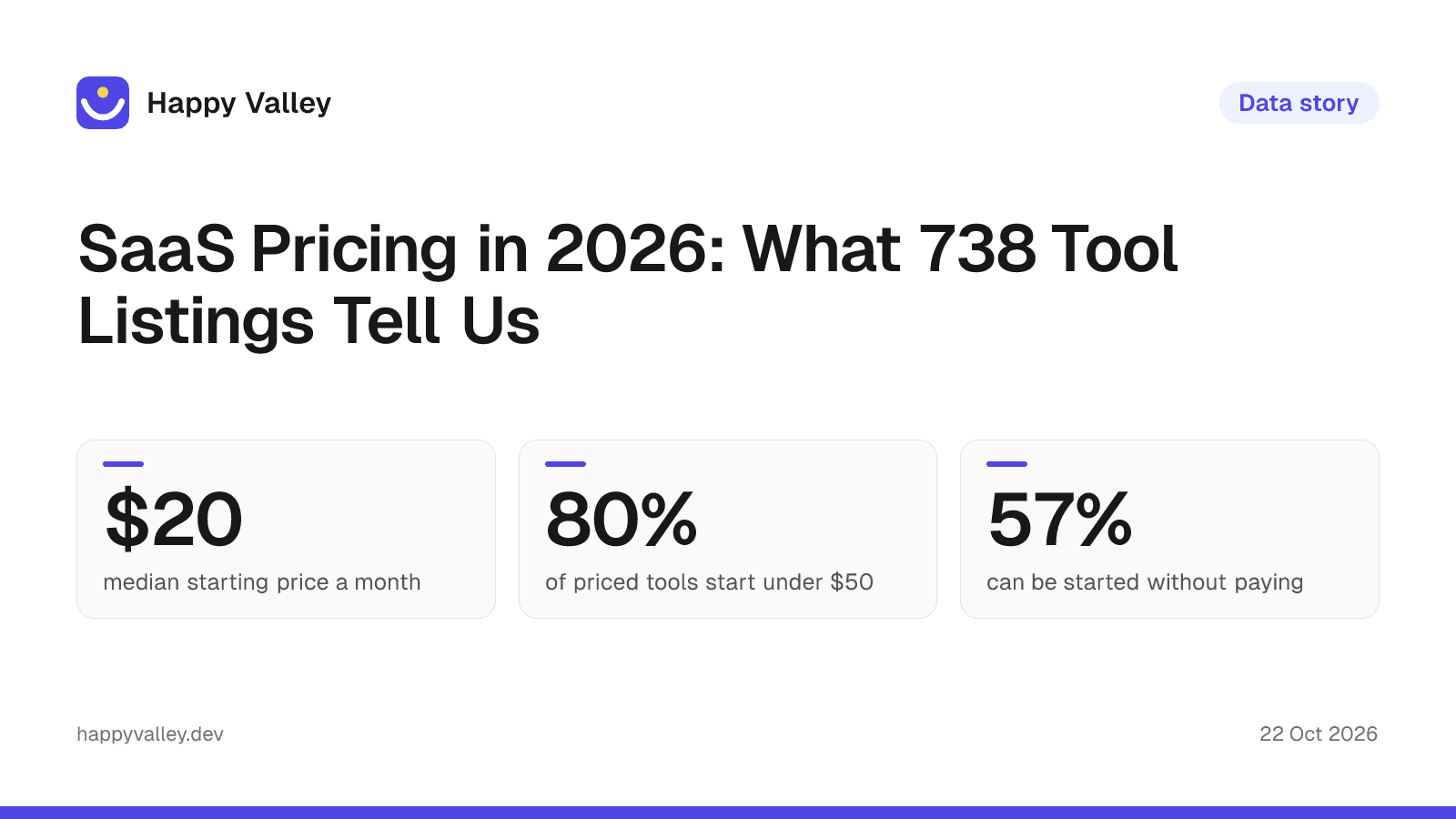
Scope: the figures in this article cover the 738 tools our editors researched and price-checked as of 22 October 2026. The live directory also lists a few maker-submitted products whose prices our editors have not checked yet (5 on this date), so site-wide counts such as the 743 on the Pricing Index are slightly higher.
Key findings
- Median starting price: $20 a month across the 532 tools that publish one. The 25th percentile is $12 and the 75th percentile is $45.
- 80% of public starting prices are under $50 a month (426 of 532). Only 10 tools start at $500 or more.
- The most common price point is $29, used by 36 tools, followed by $12 (30 tools) and $20 (28 tools).
- Pricing model mix: 48.1% freemium, 43.1% paid only, 6.4% open source and 2.4% fully free. In total, 56.9% offer some way to start without paying.
- 37% of paid-only tools have no monthly US dollar starting price in our data (119 of 318), and 59.8% of all tools list a custom or contact-sales tier.
- 43.1% advertise a free trial. The median trial is 14 days, and 57% of all trials are exactly 14 days.
- Most expensive category by median: ad management and attribution ($259). Cheapest: backup and SaaS data protection ($5).
- About half of tools with plans (52.6%) appear to price at least one plan per user, by an approximate keyword measure.
These figures are a snapshot as of 22 October 2026, computed with the same method as the SaaS Pricing Index, on the editor-verified tools only. The index recalculates every hour as tools are added or prices change, so its numbers can later differ slightly from the ones here. This article explains what the numbers mean; the index holds the full table, category by category.
How much does SaaS cost to start?
Of the 738 active tools in our catalog, 532 (72.1%) publish a monthly starting price in US dollars. The median of those prices is $20. A quarter of tools start at $12 or less, and a quarter start at $45 or more. At the edges, the 10th percentile is $8 and the 90th percentile is $100.
The average is much higher, at $71.22, because a few team-oriented products have a cheapest paid plan that already costs thousands a month. That gap is why the median is the more useful number for anyone budgeting a typical tool.
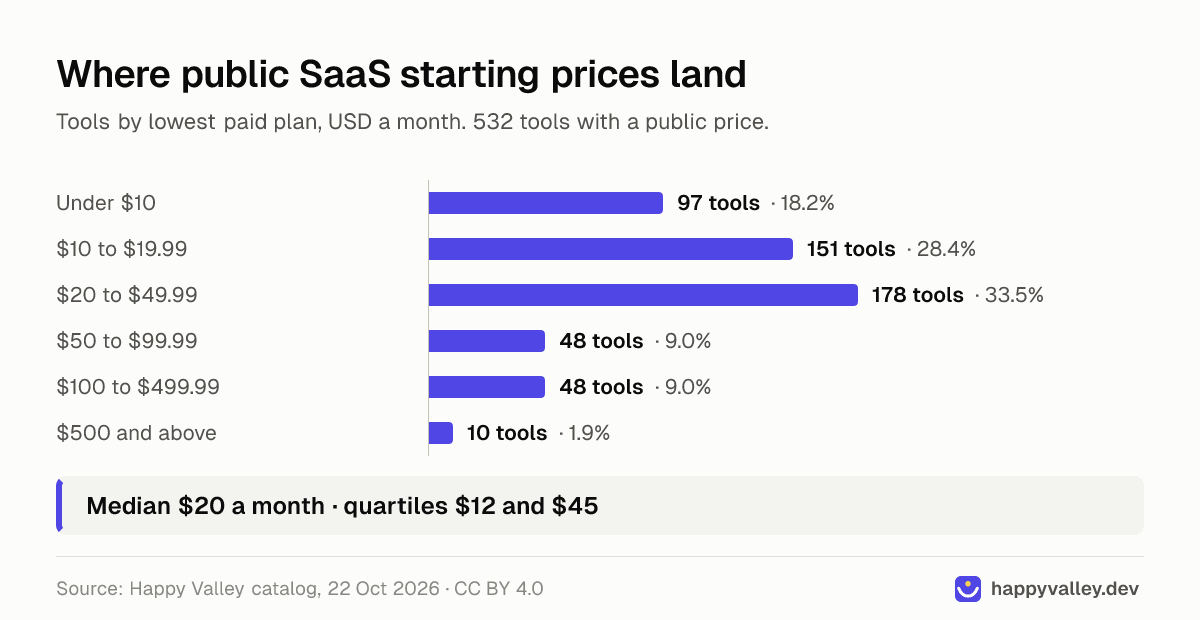
| Starting price | Tools | Share |
|---|---|---|
| Under $10 | 97 | 18.2% |
| $10 to $19.99 | 151 | 28.4% |
| $20 to $49.99 | 178 | 33.5% |
| $50 to $99.99 | 48 | 9.0% |
| $100 to $499.99 | 48 | 9.0% |
| $500 and above | 10 | 1.9% |
Prices also cluster on familiar numbers. $29 is the single most common starting price (36 tools), ahead of $12 (30), $20 (28), $15 (25) and $25 (24). Charm pricing is common but not dominant: $49, $39 and $19 each appear on 17 to 22 tools.
Pricing model mix: freemium leads
Freemium is now the most common model in the catalog, ahead of paid-only products. Open source tools usually charge for a hosted or team edition, so most of them still have a starting price.
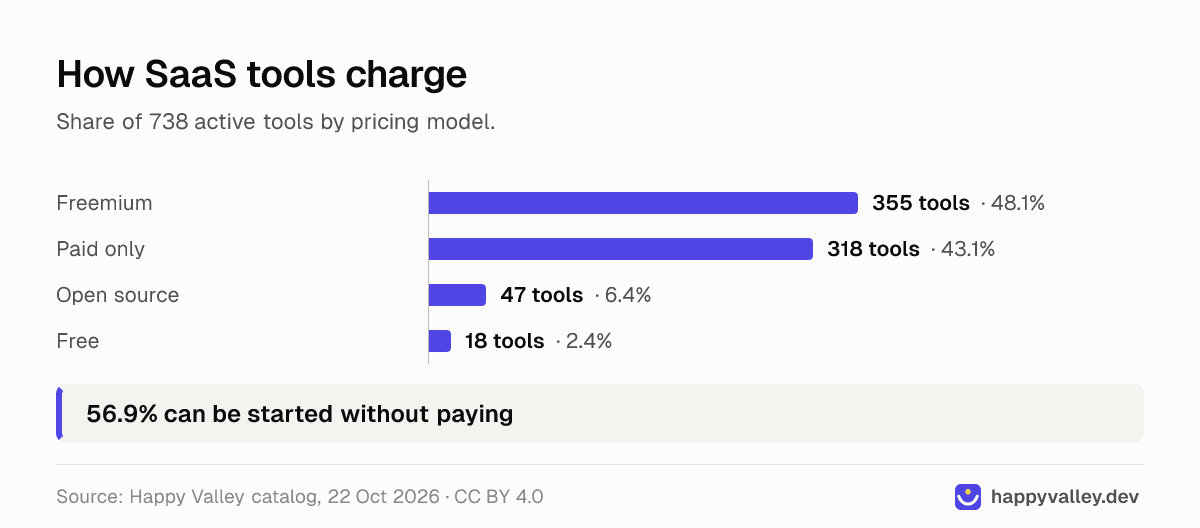
| Model | Tools | Share | Median paid start |
|---|---|---|---|
| Freemium | 355 | 48.1% | $16.99 |
| Paid only | 318 | 43.1% | $35 |
| Open source | 47 | 6.4% | $19.50 |
| Free | 18 | 2.4% | n/a |
Two patterns stand out. First, the paid upgrade of a freemium product is cheaper than the entry plan of a paid-only product ($16.99 against $35 at the median). Second, paid-only products are often not priced in public: for 119 of 318 we found no monthly starting price in US dollars. 71 of them show no price at all and quote on request; most of the rest charge in another currency, per transaction or by usage. If free entry points matter to you, our analysis of free plans in 2026 looks at what those plans actually include.
Cheapest and most expensive categories
Category medians follow the index method: a tool listed in several categories counts in each of them. The table lists the six highest and seven lowest of the 50 categories, with the number of tools that publish a price next to the number listed, since some samples are small.
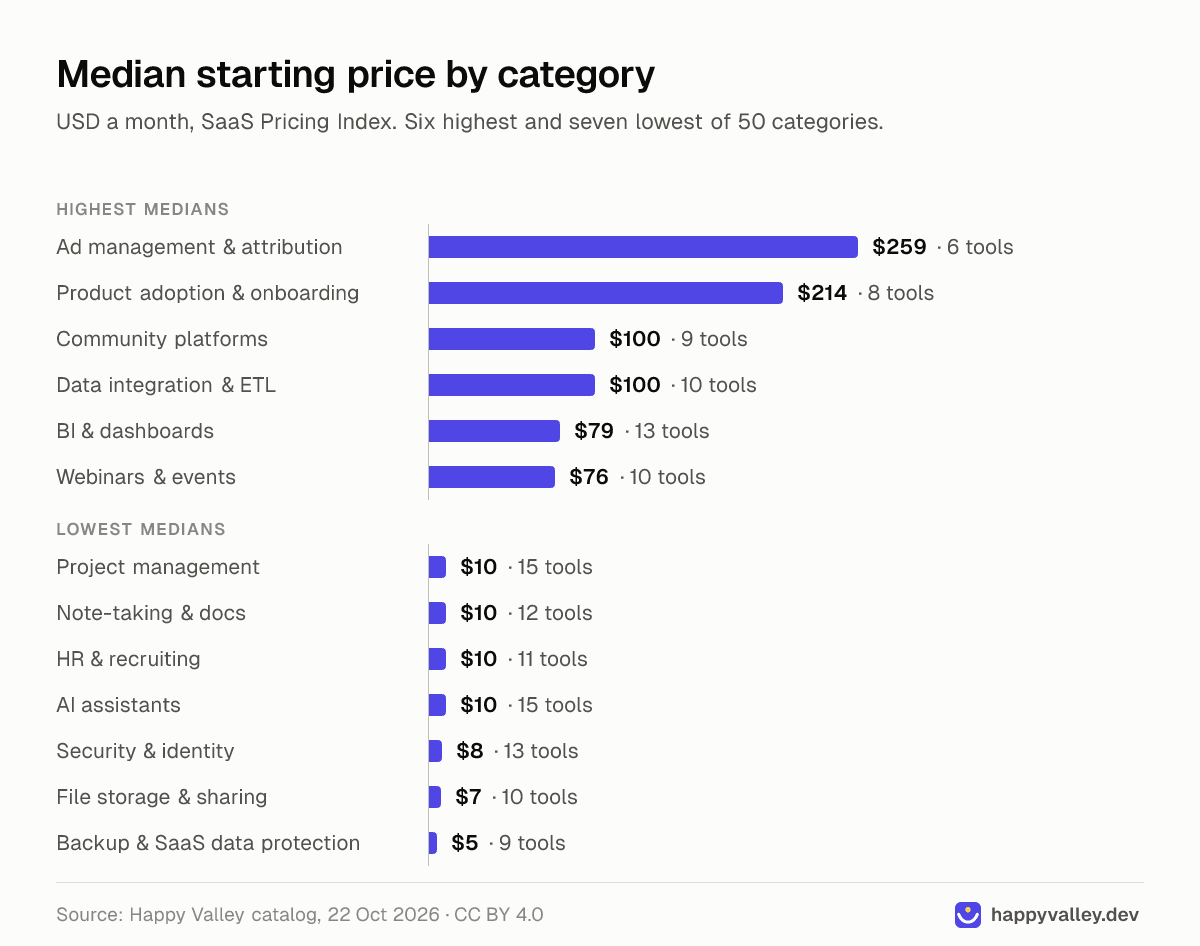
| Category | Median start | Priced tools / listed |
|---|---|---|
| Ad management & attribution | $259 | 6 / 17 |
| Product adoption & onboarding | $214 | 8 / 15 |
| Community platforms | $100 | 9 / 14 |
| Data integration & ETL | $100 | 10 / 16 |
| BI & dashboards | $79 | 13 / 17 |
| Webinars & events | $76 | 10 / 18 |
| Project management | $10 | 15 / 16 |
| Note-taking & docs | $10 | 12 / 15 |
| HR & recruiting | $10 | 11 / 20 |
| AI assistants | $10 | 15 / 21 |
| Security & identity | $8 | 13 / 24 |
| File storage & sharing | $7 | 10 / 16 |
| Backup & SaaS data protection | $5 | 9 / 16 |
The expensive end is made of tools bought by revenue, marketing or data teams, where the price tracks ad spend, contacts or data volume. The cheap end is made of tools bought per person, where a low per-user price multiplies across a team. That is why a $10 median in HR or project management does not mean those categories are cheap for a 200-person company.
The spread inside a category
Category medians hide a large spread. In BI, spreadsheets, scheduling and HR, the highest starting price in the category is at least 100 times the lowest:
- BI & dashboards: Google Data Studio Pro costs $9 per user per project, on top of a free tier. Lightdash is free to self-host, but its cheapest hosted plan, Cloud Pro, is $3,000 a month with unlimited users. The Lightdash vs Google Data Studio comparison shows how differently the two are built.
- Databases & spreadsheets: Google Sheets paid plans start at $8.40 per user on the flexible Business Starter plan, while Equals' entry plan costs $24,000 a year, or $2,000 a month, with unlimited seats.
- Scheduling: zcal's paid plans start at $7 per user, while Chili Piper's entry Routing & Scheduling plan is $1,250 a month, sold only annually at $15,000 with 15 seats included.
- HR & recruiting: Lattice starts at $4 per seat for its engagement module, while Ashby starts at $400 a month for companies up to 100 employees. See Ashby vs Lattice for what each covers.
- CRM: the gap is smaller but still wide. Twenty starts at $9 per user, while Keap starts at $299 a month with two users included. The Keap vs Twenty page sets the plans side by side.
None of these high figures is an enterprise tier. Each is the vendor's lowest published paid plan; it is high because it bundles a team of seats, unlimited users or an annual contract, or because only the managed cloud version of a free open-source product is priced. Quote-only enterprise tiers are not counted as starting prices.
Some categories are tight instead. Design tools range from $7 to $20, meeting notes and transcription from $11 to $29, and podcast and audio tools from $6 to $25. In these markets, products tend to compete on features rather than on price.
Free trials: common, short and predictable
318 of 738 tools (43.1%) advertise a free trial. The median length is 14 days, and trial lengths are highly standardized:
- 14 days: 182 tools (57.2% of all trials)
- 30 days: 58 tools (18.2%)
- 7 days: 49 tools (15.4%)
- 15 days: 19 tools (6.0%)
- Other lengths (3, 10, 21, 60 or 90 days): 10 tools
Trials are more common among paid-only products (52.8%) than among freemium ones (37.2%), which makes sense: a free plan already does the job of a trial. Category differences are sharp. Trials are near universal in CRM (15 of 18 tools) and BI & dashboards (14 of 17), and common in customer support (18 of 27). In AI image and video generation none of the 17 tools we track advertises a trial, and in AI assistants only 2 of 21 do; most of them rely on free plans with usage limits instead.
Per-seat pricing: about half, and why it matters
Per-seat pricing is still the most common unit. By a keyword measure over plan names, prices and notes, about half of the 732 tools with published plans (52.6%) price at least one plan per user. A stricter count, which only includes plans whose price is explicitly labelled per user, seat, member, agent, employee or host, finds 198 tools (27%). The real figure sits somewhere between the two. Usage signals, such as credits, contacts or events, appear in about a third of tools (36.3%). Both keyword measures are approximate.
This matters for reading every number above. A $10 per-user plan and a $10 flat plan count the same in a starting-price median, but for a team of 25 they differ by $240 a month. Our explainer on per-seat versus usage-based pricing walks through how to compare the two models on real team sizes.
Methodology and limits
- Sample: the 738 published, active tools in the Happy Valley catalog across 50 categories. The index applies the same rules and also lists maker-submitted products whose prices we have not checked yet; discontinued products are excluded from both.
- Snapshot date: all figures are as of 22 October 2026. The live index recalculates hourly as tools are added or prices change, so its numbers can later differ slightly from this article.
- How prices were checked: each tool's public pricing information was reviewed between 20 and 22 October 2026. Prices are list prices in US dollars, before taxes and discounts.
- Starting price: the lowest paid plan, expressed per month. When a vendor bills only annually, we normally use the monthly equivalent (for example, $24,000 a year becomes $2,000 a month). Free plans are excluded from every median, as in the index. With an even number of prices, the median is the midpoint of the two middle values.
- Excluded from price statistics: 206 tools with no monthly starting price in US dollars, mainly quote-only products, the 18 fully free tools, per-transaction or usage-based pricing, and 39 tools that publish prices only in euros, pounds or lira.
- Categories: as in the index, a tool that belongs to several categories counts in every one of them, so category counts add up to more than 738. The index rounds medians to whole dollars; every category median quoted here is already a whole-dollar value.
- Limits: category samples are small (4 to 32 priced tools each), so a single product can move a median. Per-user and flat prices are not normalized. The per-seat and usage shares are approximate text measures. The catalog is curated, not a random sample of all SaaS.
What the numbers mean for buyers
A typical SaaS tool starts at around $20 a month, and most start below $50. The headline price is rarely the full cost, though: watch for per-seat multipliers, annual-only billing, bundled team plans and quote-only enterprise tiers, which together account for most of the spread inside categories. Before you shortlist, compare current prices in the pricing index, browse all categories, and run through our SaaS buying checklist.
Frequently asked questions
What is the average SaaS price in 2026?
As of 22 October 2026, the median starting price across the 532 tools in our catalog with a public price is $20 a month. The mean is $71.22, pulled up by a few team-oriented products whose cheapest paid plan costs thousands a month.
How long is a typical SaaS free trial?
14 days. Of the 318 tools that advertise a trial, 57.2% offer exactly 14 days, 18.2% offer 30 days and 15.4% offer 7 days.
Which SaaS category is the most expensive?
By median starting price, ad management and attribution ($259 a month), followed by product adoption and onboarding ($214), then community platforms and data integration ($100 each). Samples are small, so treat these as indicative.
Can I reuse these figures?
Yes. Cite Happy Valley with the date (22 October 2026) and link to the SaaS Pricing Index, which is published under CC BY 4.0 and recalculated as listings change.