Turkey's SaaS Landscape in 2026: Patterns From 61 Tools
Turkish SaaS in 2026 is built around local compliance and payment rails: of the 738 active tools in our catalog, 61 are from Turkey, and 24 of them sit in just three categories (e-commerce, accounting and payments). Most sell in lira or by quote, while a smaller export-focused group prices in dollars and competes globally.
Mustafa Gezer · · 8 min read
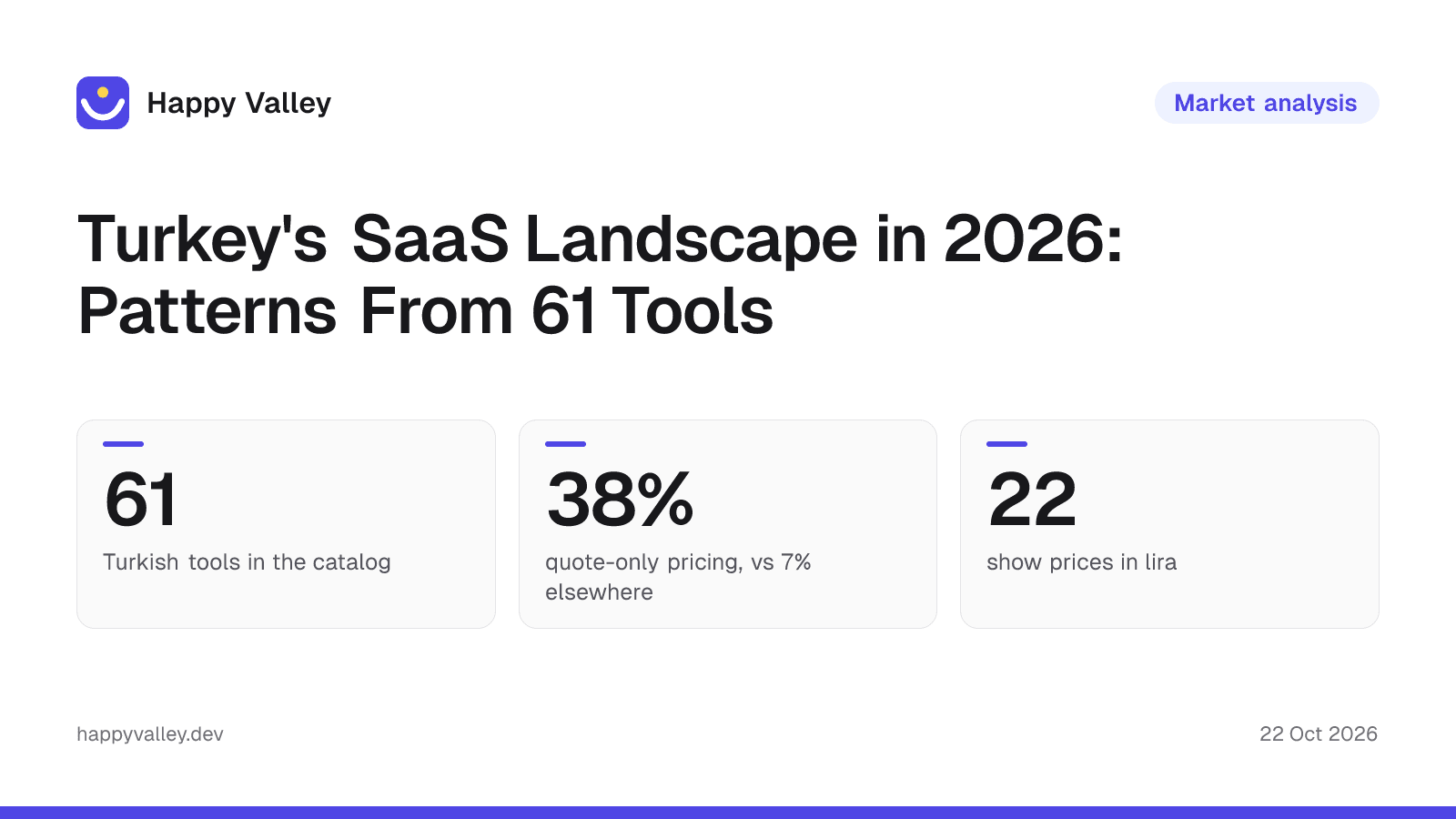
Scope: the figures in this article cover the 738 tools our editors researched and price-checked as of 22 October 2026, 61 of them from Turkish companies. The live directory also lists a few maker-submitted products whose prices our editors have not checked yet (5 on this date), which is why the Turkish SaaS page shows 63 products.
Where Turkish SaaS companies cluster
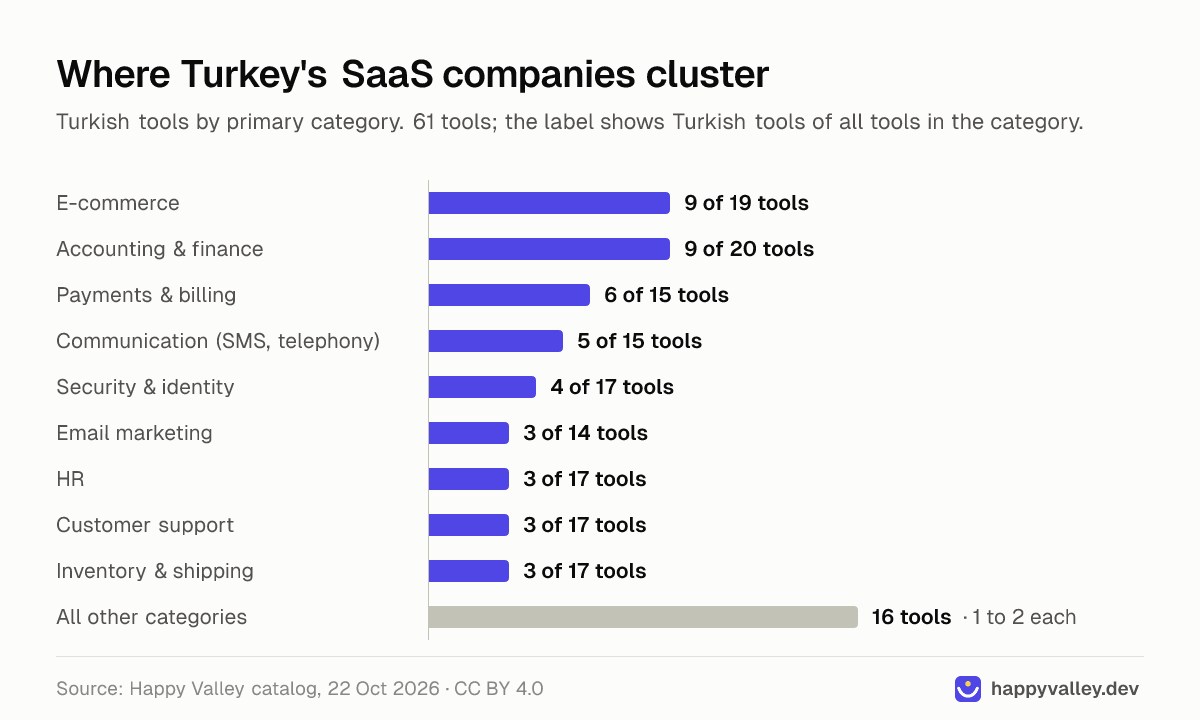
Of the 738 active tools in our catalog, 61 list Turkey as their home country. That is the second-largest country group after the United States (372), or about one tool in twelve. The 61 are not spread evenly: nine are e-commerce tools, nine are accounting and finance tools, and six are payment providers. Add five SMS and cloud telephony providers and those four groups make up 29 of the 61, just under half.
| Primary category | Turkish tools | All tools in category | Examples |
|---|---|---|---|
| E-commerce | 9 | 19 | ikas, Ticimax, T-Soft, İdeasoft, Akinon |
| Accounting & finance | 9 | 20 | Paraşüt, Logo İşbaşı, KolayBi, Nilvera, Luca |
| Payments & billing | 6 | 15 | iyzico, PayTR, Craftgate, Sipay |
| Team communication (SMS, cloud telephony) | 5 | 15 | Netgsm, Verimor, İleti Merkezi, Bulutfon |
| Security & identity | 4 | 17 | Picus Security, SOCRadar, Logsign, Brandefense |
| Email marketing | 3 | 14 | Insider, SmartMessage, Related Digital |
| HR, customer support, inventory & shipping | 3 each | 17 each | Kolay, Desk360, Sentos, Entegra |
In e-commerce and accounting, Turkish vendors make up almost half of each category in our catalog. That says less about global market size than about local need: these are the tools a Turkish business has to get right for tax and marketplace reasons, and foreign products rarely cover those requirements out of the box.
Why the clusters look like this: local rules and rails
Three sets of local requirements explain most of the clustering.
- E-invoice and e-archive. Businesses whose gross sales reach 3 million lira in 2022 or any later year must move to e-invoicing (e-Fatura) (Official Gazette, 22 January 2022). Since 1 January 2026, businesses outside the e-archive system must also issue their invoices electronically as e-archive invoices whatever the amount, apart from a few listed exceptions (Official Gazette, 12 November 2024); for small traders taxed under the simplified method or keeping business-account books, that date moved to 1 January 2027 (Official Gazette, 31 December 2025). In our catalog, 13 Turkish tools describe e-invoice, e-archive or e-ledger support, from private integrators such as Nilvera to pre-accounting apps such as Paraşüt and Logo İşbaşı, plus e-commerce platforms that issue invoices automatically.
- KVKK and where data lives. Turkey's personal data law (KVKK) was amended by Law No. 7499 in March 2024 (Official Gazette), and the new cross-border transfer rules took effect on 1 June 2024. Transfers abroad now rely first on an adequacy decision and otherwise on appropriate safeguards such as the standard contracts announced by the Personal Data Protection Board, which must be notified to the Authority within five business days of signing, or binding corporate rules (Erdem & Erdem overview). Eight Turkish tools mention KVKK and ten mention on-premises deployment. Fewer than 40 of all 738 tools in our catalog mention on-premises at all, so Turkish vendors account for about a quarter of those while being 8% of the catalog.
- Local rails: message consent, marketplaces, installments. Seven tools mention İYS, the national registry for commercial message consent, which bulk SMS providers such as Netgsm and Verimor build in. Nine integrate with Turkish marketplaces such as Trendyol, Hepsiburada or n11, and ten mention card installments (taksit).
Pricing: lira, dollars or a sales call
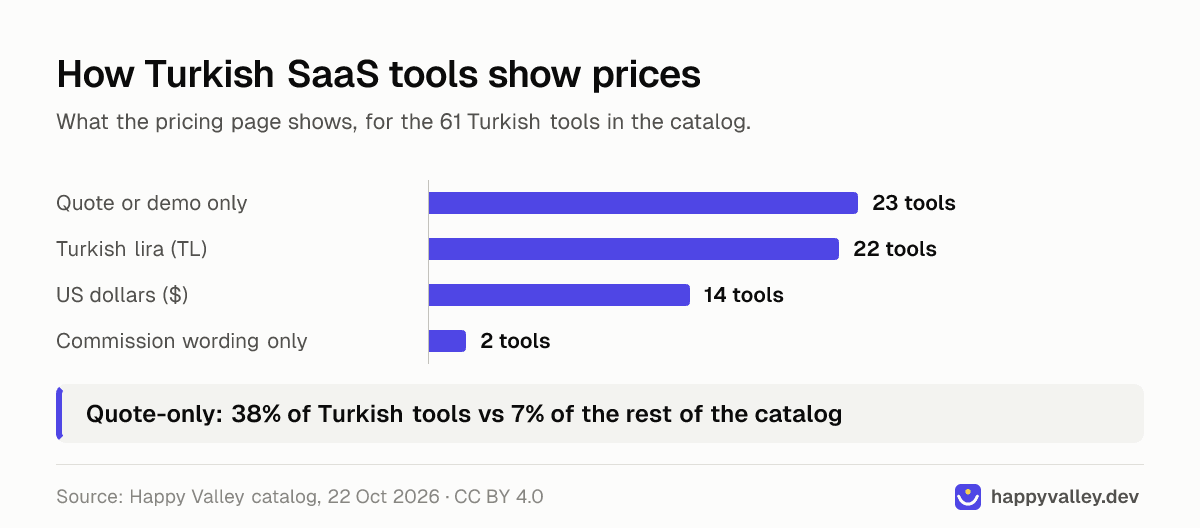
Looking at the plans each Turkish vendor publishes, pricing falls into four groups:
| What the pricing page shows | Turkish tools | Examples |
|---|---|---|
| Lira prices (₺) | 22 | Paraşüt, ikas, Ticimax, Netgsm, Luca |
| Dollar prices ($) | 14 | UserGuiding, Zeplin, Prisync, SOCRadar |
| Quote or demo only | 23 | Insider, Akinon, Picus Security, Mikro |
| Commission wording only | 2 | PayTR, Param |
The quote-only share is the clearest difference from the rest of the market: 23 of the 61 Turkish tools (38%) publish no price at all, against about 7% of the other 677 tools in our catalog. Many of them sell to banks, retailers and large enterprises, where a demo and a negotiated contract are the norm.
Pricing models lean paid as well. 49 of the 61 are paid-only, 11 are freemium, one is free and none is open source, while across the whole catalog freemium (355 tools) outnumbers paid (318). Only 15 Turkish tools state a free trial length, about 25%, compared with 43% catalog-wide. For the wider picture, see the SaaS Pricing Index and our analysis of SaaS pricing in 2026.
Lira price lists also have their own habits:
- Annual billing against a list price. ikas shows its Lift plan at ₺55,927 a year against a ₺79,896 list price, and T-Soft's Basic plan is ₺45,000 a year against ₺75,000. Annual prepayment fixes the lira price for twelve months.
- VAT stated, but not consistently. Lira prices come labelled "KDV dahil" (VAT included) or "+KDV", so two headline numbers can differ by the 20% VAT alone. Put tools such as Bizim Hesap and Paraşüt on the same basis before comparing.
- Credit packs for e-documents. e-Invoices are sold in credits (kontör): Nilvera's 1,000-credit pack is ₺2,375 excluding VAT, and Paraşüt's e-invoice-only plan bundles 120 credits.
- Commission instead of subscription. iyzico lists 4.29% + ₺0.25 per transaction for companies, while PayTR and Craftgate agree rates per merchant. The iyzico vs PayTR comparison covers the differences.
Prices are as shown on vendor pages at our latest checks in October 2026. Lira list prices change often; treat them as a snapshot.
The export group: dollar prices and global buyers
The 14 tools that show dollar prices are mostly companies that sell to foreign customers. UserGuiding sells no-code onboarding from $249 a month billed yearly, Zeplin prices design hand-off from $13.75 a month, Prisync tracks competitor prices from $99 a month, and SOCRadar sells dark web monitoring from $600 a month or $4,550 a year. Retable ($12 per user), Countly (managed cloud from $175) and Juphy, a Shopify sales assistant from $19, follow the same pattern. In five of the 14, the only dollar figure is a $0 free plan next to quote-based paid tiers.
Most of these pricing pages read like those of any international SaaS company, in English and in dollars. None of them is built around e-invoicing. That is the sharpest split in the Turkish landscape: domestic tools win on compliance and lira billing, while export tools compete on product in categories where buyers do not ask where the vendor is based.
Funding and exits: what is verified
Several of the larger recent outcomes involve companies in our catalog. We list only events with a public source:
- Insider raised a $500 million Series E led by General Atlantic in November 2024 (tech.eu). Renamed Insider One in December 2025 (Insider One), it acquired Bluecore, a retail marketing platform serving more than 400 US enterprise brands, in May 2026 to expand its North American enterprise footprint (AlleyWatch).
- Picus Security raised a $45 million Series C led by Riverwood Capital in September 2024; the report describes it as San Francisco-based (GovInfoSecurity).
- ikas raised a $20 million Series A from IFC and Re-Pie Portföy in April 2024 to accelerate growth abroad; it had opened an office in Germany at the end of 2022 (tech.eu).
- PayU announced the acquisition of iyzico for $165 million in June 2019, subject to regulatory approval (PayU). Its parent company Prosus reports that it completed the purchase of a 90% interest in December 2019 (Prosus annual report 2020).
- Saudi customer engagement platform Unifonic announced on 10 June 2026 that it had acquired Segmentify, the Türkiye-founded e-commerce personalization platform; terms were not disclosed (Unifonic).
- Enocta, a corporate learning company founded in 1999, joined Aquila in July 2026, Aquila's first investment in Turkish learning technology. Aquila invests in vertical-market software companies and is part of a group listed on the Toronto Stock Exchange; the size of the stake was not disclosed (Capital).
The largest rounds went to companies that sell to large customers abroad (Insider, Picus Security) or use a domestic base to expand (ikas); in our catalog, Insider and Picus Security publish no prices and sell by quote. The two 2026 deals for Turkish companies on this list involved a Saudi buyer and a Toronto-listed group, which suggests Turkish SaaS companies draw foreign strategic buyers, not only local ones.
What this means if you are choosing software in Turkey
- If you invoice Turkish customers, start with tools that issue e-invoices and e-archive invoices natively, or check that a foreign tool connects to a GİB-approved integrator such as Nilvera.
- Compare lira prices on the same VAT basis and billing period; many headline monthly figures are annual prices divided by twelve.
- Expect a sales call for enterprise tools: almost four in ten Turkish vendors publish no price.
- For dollar-priced tools, check whether your card is charged in USD, since exchange rate moves change the real cost over a year.
- Browse every Turkish vendor on the Turkish SaaS tools page, or read our guide to free plans if you want to start without a contract.
Conclusion
Turkey's SaaS landscape in 2026 has two layers. The domestic layer is shaped by e-invoicing, KVKK and local payment rails; it sells in lira, often by quote, and concentrates in accounting, e-commerce, payments and messaging. The export layer prices in dollars and competes globally in onboarding, design, security and analytics. The largest funding rounds went to enterprise vendors that sell abroad by quote, such as Insider and Picus Security, while recent acquisitions brought in foreign buyers. Both layers are listed on our Turkey page.
Frequently asked questions
How many Turkish SaaS tools are in the catalog?
61 of 738 active tools as of 22 October 2026, the second-largest country group after the United States.
Do Turkish SaaS companies price in lira or in dollars?
Both. 22 publish lira prices, 14 show dollar prices and 23 publish no price at all; dollar pricing is mostly used by export-focused companies such as UserGuiding and Zeplin.
Why are so many Turkish SaaS tools in accounting and e-commerce?
Local requirements such as e-invoice and e-archive, marketplace integrations and card installments are hard for foreign tools to cover, so domestic vendors fill these categories.
Which Turkish SaaS companies raised large rounds recently?
Verified examples include Insider's $500 million Series E and Picus Security's $45 million Series C, both in 2024, and ikas's $20 million Series A in April 2024.
Are free trials common among Turkish SaaS tools?
Less common than elsewhere: 15 of 61 state a trial length (about 25%), compared with 43% across our whole catalog.